Empires Don't Fall. They Rot.
How Belief Collapses, Power Thins, and Rule Becomes Performative.
Many people have been led to believe that empires collapse in a fiery storm. That image is comforting, but it is not reality.
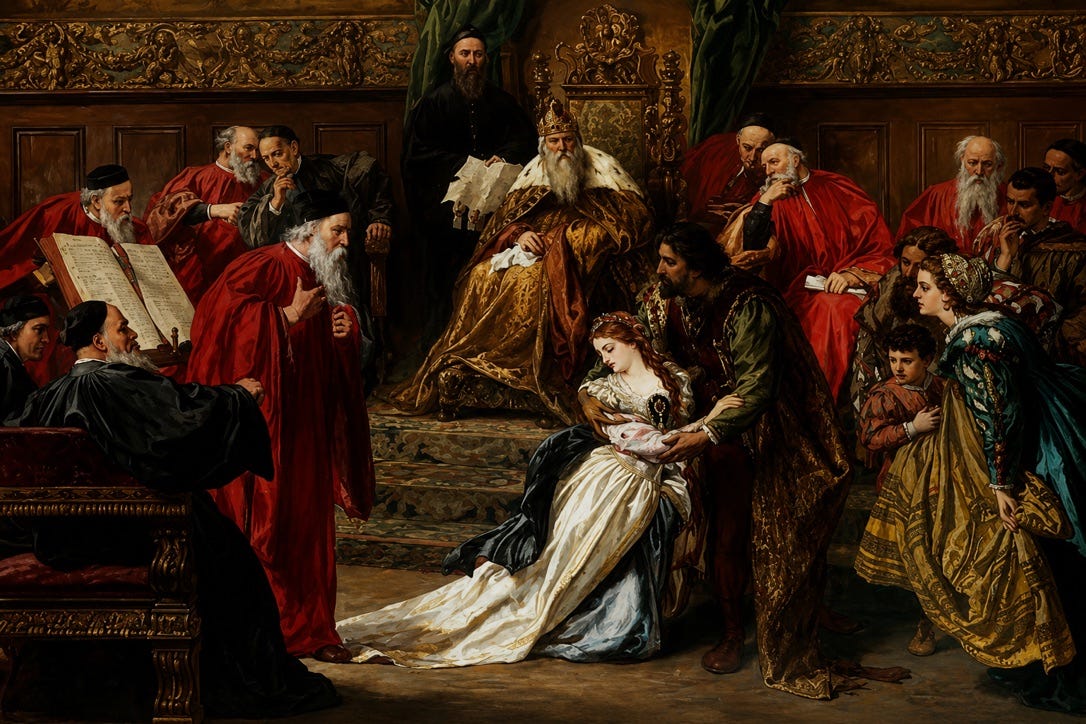
Most great empires collapse slowly and bureaucratically. Not through sudden destruction, but through erosion. They lose belief in themselves first. They lose pride. Ambition stops being restrained and turns inward, consuming the very structures it once depended on. Moral decadence does not arrive as scandal. It arrives as normalization. This feels foreign because of how history is usually taught. We are shown dramatic events and isolated moments, stripped of the broader context needed to understand collapse as a process. The emphasis is always on the explosion, never on the years of quiet decay that made it inevitable. In reality, the collapse of empires is boring. It is managed. It is administrative. It does not arrive as a violent break before darkness, but as continuity that no longer means what it once did.
The Roman Republic before Caesar crossed the Rubicon is a clear example. By that point, political violence had already been normalized. Senators relied on mob violence to gain advantage when persuasion or law failed. Prominent political figures were not simply opposed, but eliminated. Tiberius Gracchus was politically executed in 133 BC, not as a chaotic accident, but as a signal that force had entered Roman politics. This violence did not overturn the Republic overnight. It did something far worse. It hollowed it out. Once violence became acceptable, the principles that had restrained earlier generations stopped mattering. Norms held only when they were convenient. Tradition no longer restrained ambition, it merely slowed it when possible.
Another sign of this collapse was the privatization of the Roman army. Soldiers were no longer loyal to the Republic as an institution, but to individual generals. Commanders paid their troops directly and promised land and wealth in return for service. Loyalty followed incentives. Men became faithful to patrons rather than to Rome itself. Duty to the Republic was replaced by dependence on those who could provide security and reward.
This shift went largely unnoticed. It was still fatal. A republic cannot survive when its armed force answers to private interests instead of public authority. Power had already moved away from institutions long before it was formally seized. These were not isolated failures. Courts were routinely bought by wealthy elites to enforce political agendas under the appearance of legality. Laws remained on the books, but justice became selective. To the average Roman citizen, daily life felt mostly unchanged. The Senate still convened. Offices still existed. The Republic still appeared intact. That was the problem. Beneath the surface, everything essential had already changed.
The British Empire shows the same pattern. It did not collapse because it suddenly lost the ability to rule or because it was overwhelmed from the outside. It collapsed because it stopped believing in the legitimacy of ruling at all. Authority slowly shifted into administration. Empire became something to manage carefully rather than something to defend or even justify. The language changed first. The structures lagged behind. Decisions were framed around efficiency, cost, and optics, not conviction. Britain still knew how to govern, but no longer seemed certain that it should.
Withdrawal followed the same logic. Retreat was not treated as loss, but as progress. Decolonization was framed as moral advancement, as modernization, as something enlightened rather than surrendered. Power was not violently taken from Britain. It was handed away gradually, often described as necessary or even virtuous. Parliament continued to function. Institutions remained intact. Daily life felt normal. Nothing appeared broken, which is why almost no one experienced it as collapse. There was no singular moment where everything clearly ended. No obvious breaking point forced recognition. The empire did not fall apart in a dramatic crisis. It thinned. It receded. It dissolved through a series of decisions that, taken individually, seemed reasonable and, taken together, ended imperial rule.
Collapse, then, is rarely experienced as collapse. It is experienced as continuity. The structures remain. The language persists. Life goes on largely uninterrupted. What disappears first is not order, but belief. By the time the change becomes visible, it has already been normalized. The republic is already hollow. The empire is already thinning. What feels like stability is often just the final stage of decline, when everything still works, but nothing means what it once did.

