Greed Is Gain
Seizing Advantage in a Society That Rewards Appetite
Greed should not be condemned. It should be used to gain an advantage in a society defined by decadence and degeneracy.
Greed doesn’t destroy societies. It exposes them. Greed is always present. It’s irrelevant on its own. What matters is whether a society still knows how to punish its expression. When greed becomes advantageous rather than dangerous, the internal order is already gone. Collapse is already in motion.
People treat greed like a cause. Like it appears first and then pulls everything down. That’s backwards. Greed becomes visible after restraint weakens. A stable society makes greed costly. A failing one makes it efficient. That inversion is not subtle. It’s definitive.
Once greed is rewarded, behavior simplifies. People stop hiding motives. Appetite becomes strategy. Extraction becomes intelligence. That shift tells you everything you need to know about the trajectory of a system. Every human knows something without instruction. Taking from others because you want to is wrong. That intuition exists before law, before doctrine, before argument. It does not stop greed from arising, but it establishes the boundary that keeps it contained. When that boundary is enforced, order persists. When it’s removed, greed advances openly. This isn’t moral philosophy. It’s mechanics. The problem is not greedy thoughts. The problem is when greed stops carrying consequence. When restraint produces loss and aggression produces gain, escalation is inevitable.
That’s what decadence actually is. Not spectacle. Not excess. Not shock. Just the removal of limits. Once appetite stops being restrained, it starts organizing behavior. At that point greed is no longer personal. It’s systemic. And once something is systemic, pretending it’s about individual virtue is dishonest. A greedy environment is easier to navigate, not harder. Greed strips complexity from people. It compresses motives. A greedy actor is predictable. He reaches early. He overextends. He assumes momentum will protect him. He mistakes opportunity for permanence. He cannot help it. Most people react to greed emotionally. They condemn it. They oppose it directly. They posture. That reaction is useless and self destructive. Greed doesn’t collapse under criticism. It collapses when it encounters itself.
Greed cannot coexist peacefully. Alignment between covetous actors is temporary. Trust is conditional. Loyalty lasts exactly as long as advantage does. The moment pressure increases, greed fragments. That isn’t a flaw. That’s the mechanism.
Using greed against greed does not require embodying it. It requires refusing to share its urgency. Greedy actors rush. They demand immediacy. They force premature commitment. The one who waits gains leverage automatically. Restraint dominates appetite every time. History is explicit about this phenomenon.
This article is free.
If you support our work and want access to deeper frameworks, extended essays, and longer-form analysis built on the same ideas, you can subscribe to the paid tier.
It exists to sustain the work and expand it.
Thank you for your support!
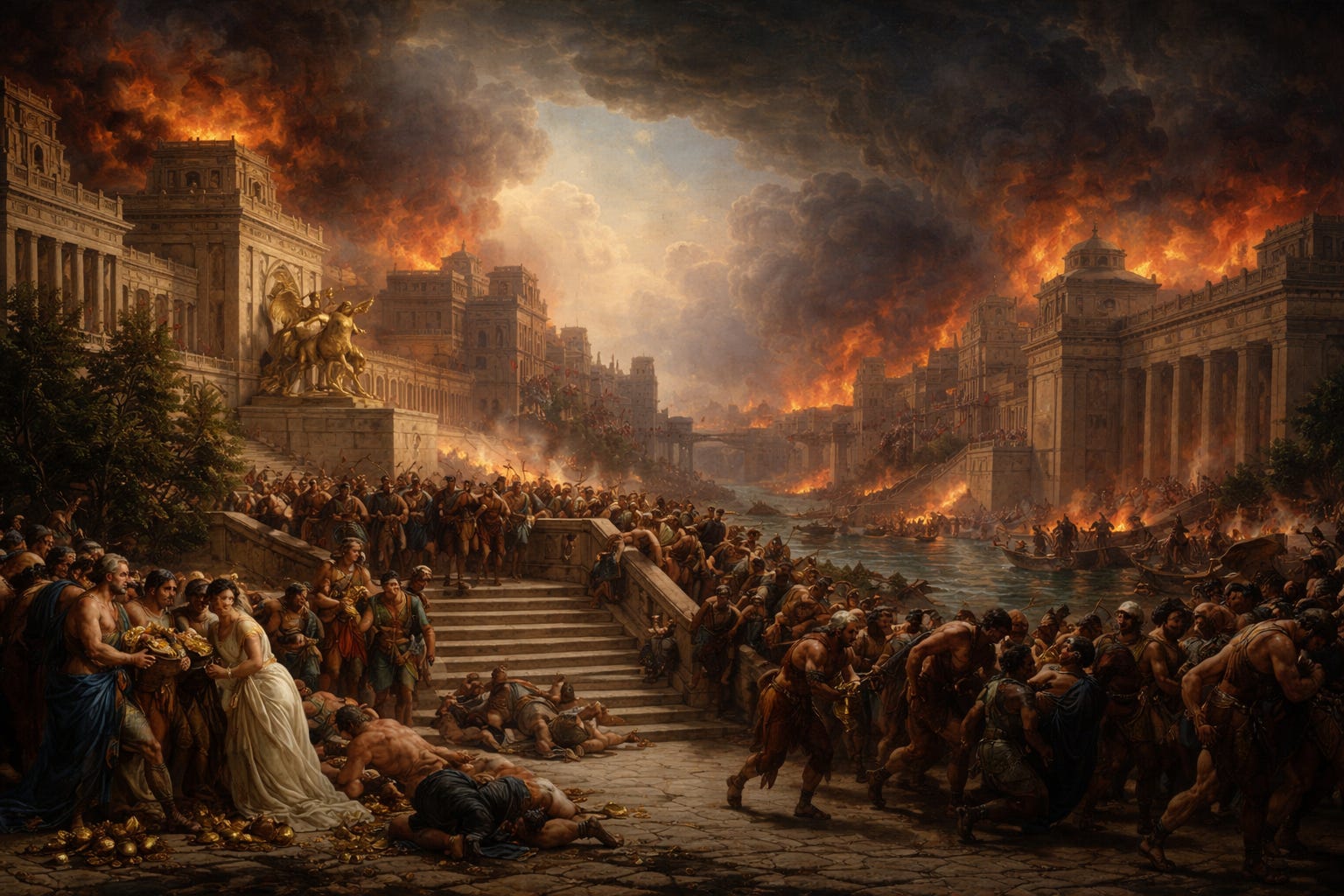
Rome did not fall because ambition appeared. It fell because ambition stopped being restrained. Elites competed openly, hollowing institutions to weaken rivals. Each believed he could use the greed of others without being consumed by it. Instead, greed consumed the system itself. Declining societies always produce predatory elites. Stewardship disappears. Extraction replaces responsibility. Norms are enforced selectively. Competition intensifies. Greed multiplies conflict faster than it produces order. Those who survive these environments are not the loudest or the most aggressive. They are the most controlled. Greed narrows vision. The greedy see gain. They do not see constraint. They collide with limits they assumed no longer existed.
Moral objections miss the point. Calling the strategic use of greed immoral is not an argument. It’s cowardice. It forces a false purity test in a world governed by incentives. That posture does not preserve virtue. History does not move according to moral declarations. It moves according to pressure, reward, and constraint. Those who refuse to understand that don’t improve outcomes. They simply remove themselves from influence. Civilizations have always neutralized one vice with another. Competing ambitions were balanced to prevent consolidation. Rival elites were allowed to check each other where law could not. Power was contained through counterweights, not idealism. This was not cynicism. It was necessity.
Moralizing greed instead of understanding it keeps people predictable. It frames clarity as contamination. Those who accept that framing remain reactive. Those who reject it are treated as dangerous. Greed is understood as wrong. It is also a signal of decline. Both are true. That does not make it unusable. It makes it viable in times of societal decline.
Greed will exist whether it is named or not. The only question is who understands how it operates and who is ruled by it. Using greed against greed is not corruption. It is recognition. Whether someone chooses to act on that recognition is contingent on character. The weak will moralize. The strong will utilize. The utilization is not evil, it is practical, logical, and essential to gain advantage.