
The Hollow Empire I
Part I: Babylon As The Architecture Of Excess

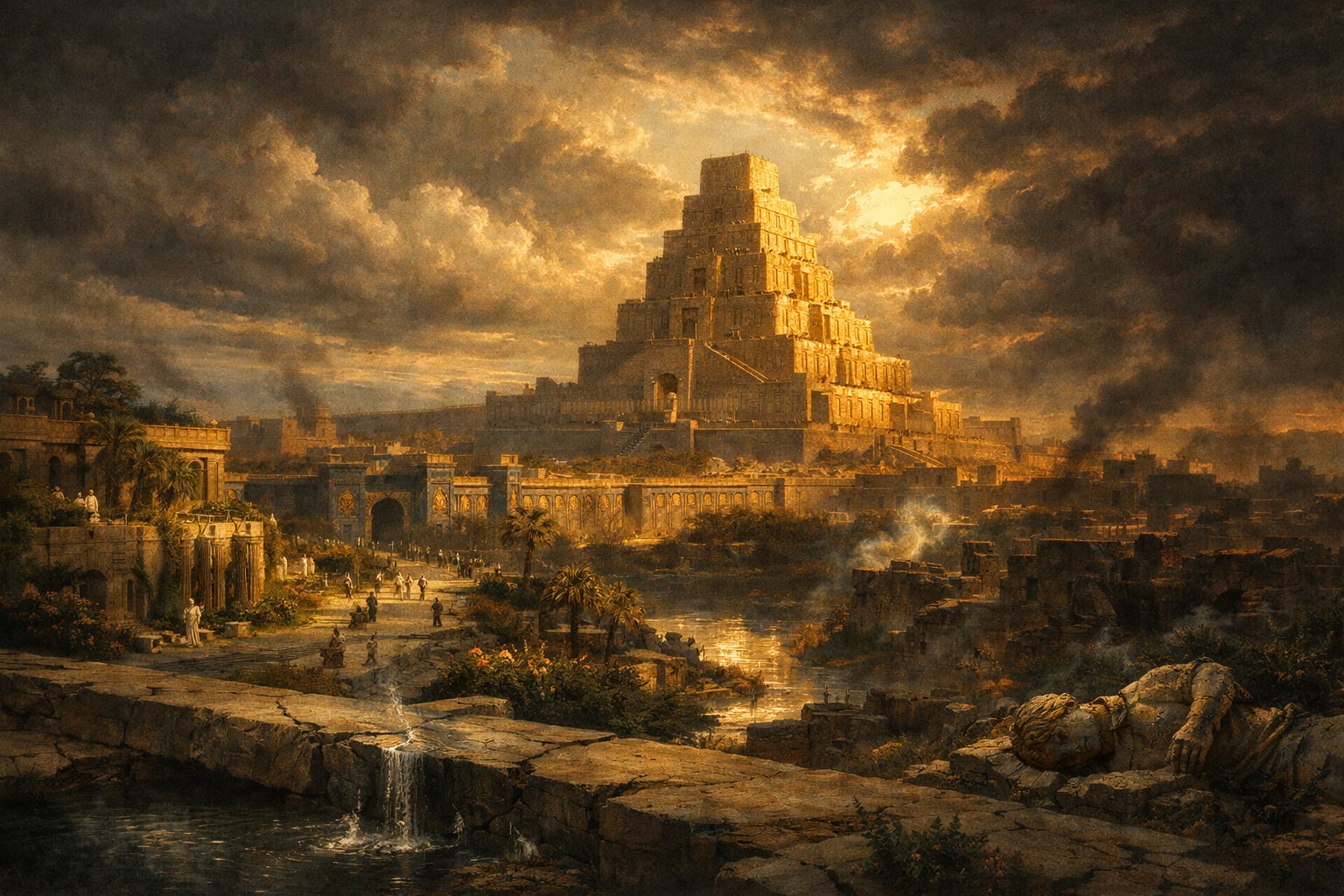
The Hollow Empire” is foundational work written months ago, before our frameworks were clearly articulated and before our Substack existed. It was originally part of our Codex I eBook series. Now it is time for our most valued members to see it in full.
This book examines how empires hollow out from within long before external collapse becomes visible. The Introduction is free, but the remaining chapters are reserved for paid subscribers. This is not to exclude our free readers, but to honor those who supported this work before it ever reached Substack. The value of this series is immense. You will see history in a whole new scope.
Some of the language and assumptions in this work reflect earlier articulations of ideas that have since been refined. Where ideas differ from our current frameworks, understand that these foundations shaped the ideas and frameworks as they exist today.
If you would like full access to the full Hollow Empire series, subscribe today and see the raw ideas that shaped our frameworks and assumptions.
INTRODUCTION: The Illusion of Permanence
They all thought they were different.
From Babylon’s gilded gates to Rome’s marble halls, from the disciplined march of Athenian ideals to the iron reach of the British Empire—each believed they were immune to the fate of those before them. Each believed their power was not just dominant, but divine. Permanent.
This is the first lie every empire tells itself:
That permanence is a reward for greatness.
But history does not reward.
It repeats.
It does not honor ambition.
It exposes it.
And it does not forgive those who forget the laws written not in ink, but in ash.
The Pattern
There is a pattern to all collapse.
It is not political. Not economic. Not even military.
It is moral.
And it begins in the soul long before it infects the senate, the crown, or the market.
“The strength of a nation derives from the integrity of the home.”
— Confucius
Civilizations rot the same way men do—quietly at first, then all at once.
First, they abandon discipline. Then they outsource responsibility. Then they crucify the truth.
By the time the walls fall, the fall has already happened.
The Cycle of Empire
It begins in hardship.
A rising empire is lean, brutal, obsessed with survival. It exalts duty over comfort and virtue over opinion. Its enemies are clear. Its values are unshaken.It matures through conquest.
Expansion feeds glory. The borders stretch. Infrastructure flourishes. Culture blooms. But within that success lies a seed—the illusion that the pain is over.It declines in comfort.
The children of warriors become the worshippers of pleasure. Luxury is no longer the reward—it is the identity. Virtue is replaced with value. Truth with tolerance. Strength with sensitivity.It dies in delusion.
Institutions remain, but the spirit is gone. Armies are still funded, but the will to fight is not. Debate continues, but without consequence. Collapse is not noticed until it is irreversible.
And yet every empire, without fail, believes it will be the one to break the cycle.
As if eternity were earned, not feared.
The Religion of Progress
Modern minds scoff at these warnings.
They have built their own altars to efficiency, equity, and the myth of linear progress.
They do not believe in sin, only statistics. Not character, only policy.
Their gods do not judge, they manage.
But the truth remains, brutal and unchanging:
There is no innovation that can save a civilization that has lost its will to suffer for what is right.
“To preserve liberty, it is essential that the whole body of people always possess arms, and be taught alike, especially when young, how to use them.”
— Richard Henry Lee
The death of empires begins when morality is privatized and pleasure becomes the new public good.
What follows is not war. It is decay—disguised as peace.
What This WORK Is…
This is not a work of history. It is a weapon.
A mirror held to every throne and every citizen who thinks they are untouchable.
We will not simply recount the fall of civilizations.
We will dissect them.
Babylon: killed by excess.
Athens: killed by ego.
Rome: killed by comfort.
The French: killed by revolutionary fervor.
The British: killed by civilized decay.
And the modern West? That is interesting…
Each section will pull from the actual words of those who ruled, advised, or warned.
Their words are not ancient, they are still happening.
A Final Warning
Empires fall. But they do not vanish.
They live on in the minds of their descendants, either as warnings or as blueprints.
The only question is whether you inherit the decay or recognize the pattern in time to break free from it.
“The evil that men do lives after them.”
— Shakespeare
The hollow empire is not a place.
It is a condition.
And you may already be inside it.
CHAPTER 1: Babylon The Empire of Excess
Before Rome became marble, before Athens dreamt of democracy, before the empires of steel and steam, there was Babylon, an empire so wealthy, so ornate, that it seemed more myth than memory.
