
The Illusion Of Independent Thought
How Moral Slogans Replace Structural Thinking

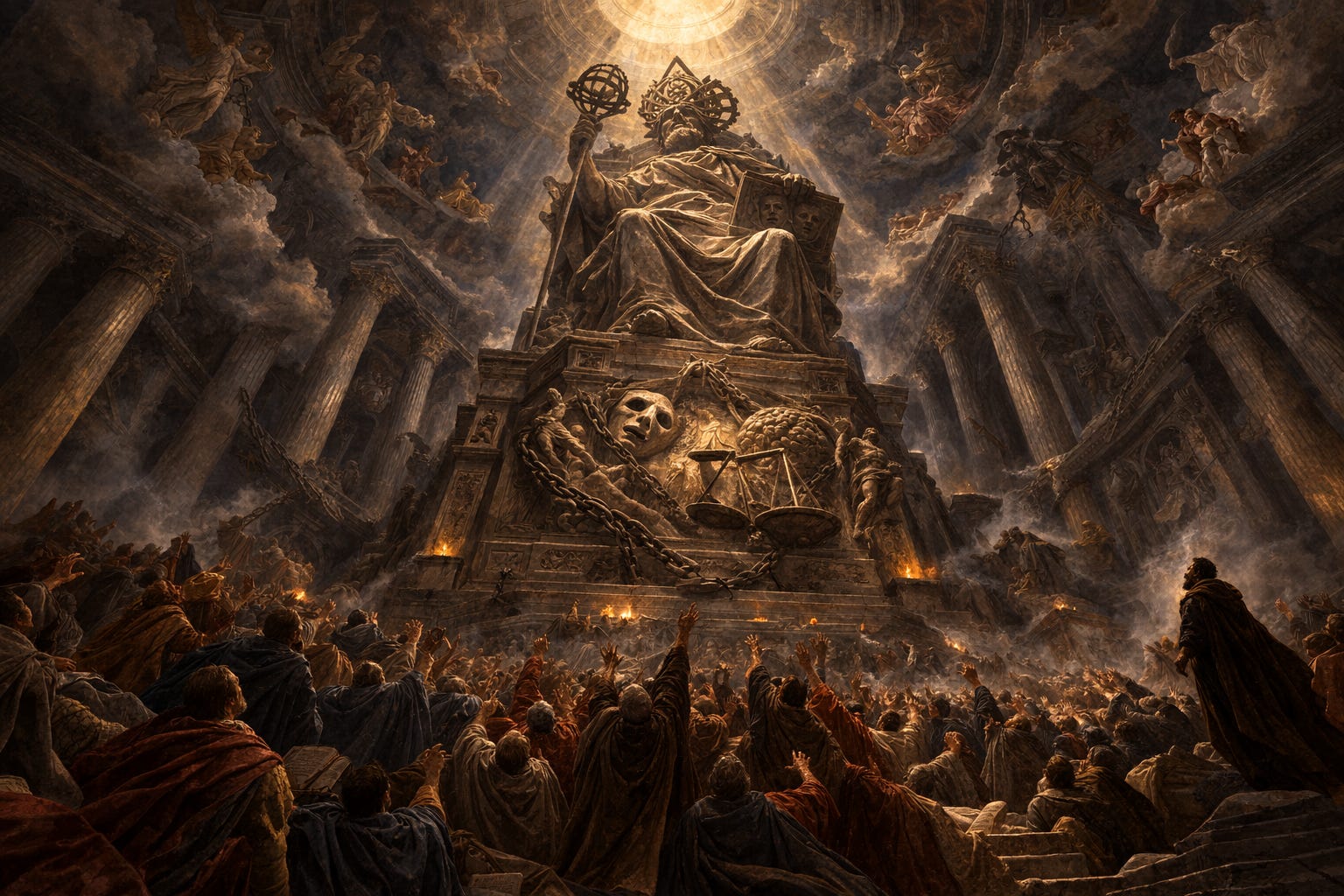
The masses have a penchant for platitudes that compress complex topics into moral slogans that simulate depth rather than provide it. A simple sentence such as “Those who cannot think for themselves are ruled by those in power.” But the reality is that sentence simulates depth while being an incomplete thought. If one cannot think, one will not be able to form any opinions or beliefs for oneself. That is evidently accurate. It is also probable that the people in power who have already captured institutions and the modern education process are shaping what the masses believe. This platitude appears to be profound, but in reality it is a compressed idea that is incomplete.
In reality, this sentence means something far more disturbing than most will admit. The masses are fickle; they will support something because it is popular, with no basis except that it aligns with their inherited ideological foundations. Many people presume to be free thinkers, but in reality they simply have a deeper understanding than most about how their thoughts are formed. Still, their thoughts are inherited and never truly examined.
For example, a man may reject one political orthodoxy only to adopt its fashionable inverse, believing himself independent while merely relocating within the same conceptual framework. Or he may critique institutions yet retain the very moral premises those institutions supplied, never questioning the soil from which his dissent grows.
That is why this sentence is dangerous. People believe they think independently when, in reality, only a small percentage of the entire populace can think freely. The group of free thinkers being so small is a symptom of mass media, approved ideological pathways, and entrenched societal norms. It takes courage to think freely because one must be able to see things outside of personal convictions. That is difficult for the masses. One must be able to think beyond current societal norms and sanctioned ideological stances.
The masses stop at the surface.
The few go beyond and unlock deeper insight.
Upgrade to a paid subscription and become part of the few.
If you upgrade YOU will receive:
• Access to Foundational Works — long-form structural essays that form the intellectual core of Philosophy Thoughts
• 2+ essays per week on power, history, and reality, with deeper analytical frameworks
• Expanded privileges in the Subscribers Chat — launch threads, request deeper analysis, and influence future essays
Many people cannot do that because they have been trained in the manner of thinking that the current power structure imposes. The masses are taught to punish and exile taboos and seemingly morally hazardous ideas. This happens in every society throughout history. In Athens, Socrates was executed for corrupting the youth and questioning sacred assumptions. In various modern regimes, dissenters have been ostracized, deplatformed, or socially exiled for challenging prevailing ideological doctrines.
One can infer from the above that a group thinks what it is told to think, not what is necessarily accurate. Groups think along approved ideological pathways, not based on foundational examination of their assumptions about the world. This is the issue. Groupthink collapses nuance in every discussion and moralizes it. It reduces complexity and creates a false dichotomy of virtuous versus evil within a society.
The masses do not demonstrate an ability to think. They repeat inherited ideas or approved mass narratives that sound correct but have never been examined rigorously. That is why platitudes like the one above, which simulate depth, are not dismissed as incomplete thoughts but treated as profound metaphysical insight. They appear intelligent and elevated, yet they remain unfinished. That is a designed way of thinking.
If one can hear a platitude, feel depth, and fail to recognize its incompleteness, they integrate those unexamined assumptions into their worldview. They then test new ideas against these assumptions through heuristics. For instance, many people believe they can think independently because they occasionally disagree with authority, yet their disagreement operates entirely within boundaries authority has already defined. They mistake deviation within a corridor for freedom outside the structure.
Heuristics are how most people interpret the world. The problem is that these heuristic models are often incomplete, not because the individual is malicious or unintelligent, but because modern thought does not reward depth or actively encourage the challenging of fundamental beliefs. It rewards alignment with common tracks of thought, such as liberalism. Any attack on liberalism as a train of thought is treated as evil.
Modern thought places self-identity at the center of most discussions. When reality or an assumption destabilizes a person’s sense of self, they collapse the argument into virtuous versus evil. An attack on identity is treated as an attack on the individual, and it is met with swift denial and reinforcement through crude but self-reinforcing mechanisms.
This is why free thought will always be rare. Modern thought, and the process of examining metaphysical realities, has elevated the self above truth. Most people are unwilling to destabilize identity in pursuit of truth. The many would rather live within a comforting illusion than confront a harsh reality.
Huh? The illusion! I need to read this.
thats really rich