
The Madness Of The Masses
How Emotion and Momentum Override Reason at Scale

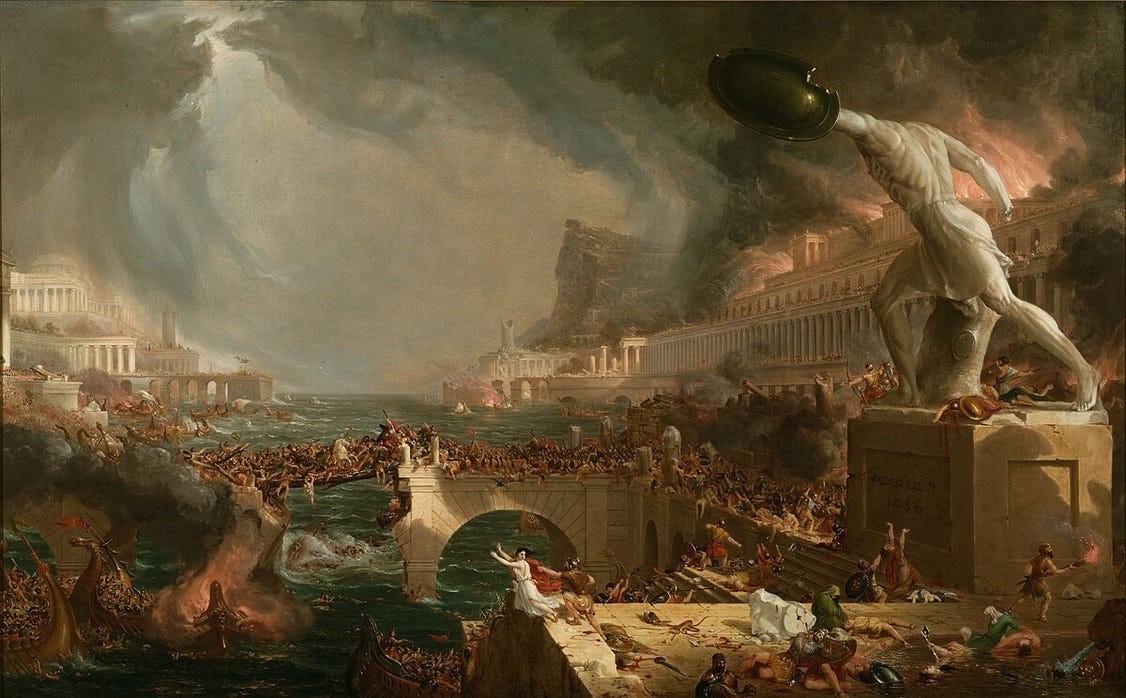
Friedrich Nietzsche remarked that one madman is dismissed as insane, while ten thousand of them are recognized as a political party.
He was not offering a clever aphorism. He was describing a recurring social phenomenon. What appears pathological in isolation becomes normalized once it acquires scale. Numbers do not refine belief. They insulate it. Error does not vanish when shared; it becomes less visible.
The manipulability of the m
asses is not an anomaly. It is a feature of collective behavior.
This pattern long predates modern politics. It has appeared wherever large groups have been mobilized under emotional pressure. And contrary to comforting narratives, mass movements do not typically originate in delusion. They begin with grievances that are, at least initially, intelligible.
Fear of exclusion. Fear of unaccountable authority. Fear of dispossession or irrelevance. These concerns are often grounded in reality. That is precisely why they function so effectively as points of entry.
Before the French Revolution hardened into terror, it began with food scarcity and political exclusion. Before the Roman Republic fractured under internal strain, popular movements arose claiming to defend ordinary citizens against entrenched elites. Before the Peasants’ Revolt in medieval England turned violent, it was driven by taxation and the absence of representation. In each case, the initial complaint was not imaginary.
What followed was not inevitable, but it was predictable.
Once collective emotion takes hold, cognition changes character. Fear narrows attention. Anger simplifies causation. Moral outrage accelerates judgment. Individuals do not stop thinking, but their thinking becomes selective. Information that reinforces the shared grievance is absorbed readily; information that complicates it is treated with suspicion or hostility.
At this stage, momentum begins to matter more than accuracy.
Beliefs are no longer assessed primarily on whether they are true, but on whether they sustain cohesion. The implicit question shifts, often unnoticed, from “Is this correct?” to “Does this preserve alignment?” Once that shift occurs, the movement becomes vulnerable to redirection.
This is where power intervenes.
Influential actors rarely generate mass emotion from nothing. They inherit it. Their task is not to persuade the crowd of a new feeling, but to give existing feelings structure: language, symbols, adversaries. Complexity is reduced. Systemic problems are personalized. Abstract forces are translated into visible opponents.
Simplification is not a flaw in this process. It is the mechanism.
As beliefs consolidate, identity follows. Positions become markers of belonging. To question them now carries a social cost. Agreement is rewarded with inclusion; doubt is met with suspicion; silence becomes a survival strategy. Enforcement no longer requires authority. The group disciplines itself.
This is the point at which collective behavior stabilizes into something resembling madness, though it does not feel that way from within.
Participants experience heightened purpose, not confusion. Emotional intensity is interpreted as moral clarity. Certainty is mistaken for insight. The greater the unanimity, the stronger the conviction appears.
History offers no shortage of examples. In late Republican Rome, crowds believed they were reclaiming political agency while ambitious figures used them to dismantle rivals. During the French Revolution, popular movements spoke the language of justice even as power concentrated into fewer hands. The masses consistently perceive themselves as actors. In practice, they are often instruments.
While attention is focused outward, leverage shifts elsewhere. While public conflict escalates, private decisions are finalized. While moral narratives dominate discourse, power reorganizes quietly.
This is the enduring deception.
The masses imagine themselves as the authors of historical change. More often, they are the medium through which it is executed. Those who understand the dynamics of collective psychology do not fear crowds. They anticipate them. Those who do not are absorbed by them.
And the most disquieting aspect is not the outcome, but the experience.
None of this feels irrational while it is occurring. It feels necessary. It feels justified. It feels urgent.
Madness at scale does not announce itself as madness. It presents itself as consensus. By the time the underlying structure becomes visible, the consequences are already fixed.
The question, then, is not why the masses become unmoored.
It is how often momentum has been mistaken for truth, and whether you recognized the difference at the time.
How to Detach Yourself from the Crowds Madness
