
Why Societies Truly Collapse
It’s not just elites, corruption, or bad leaders. History shows collapse requires mass participation.

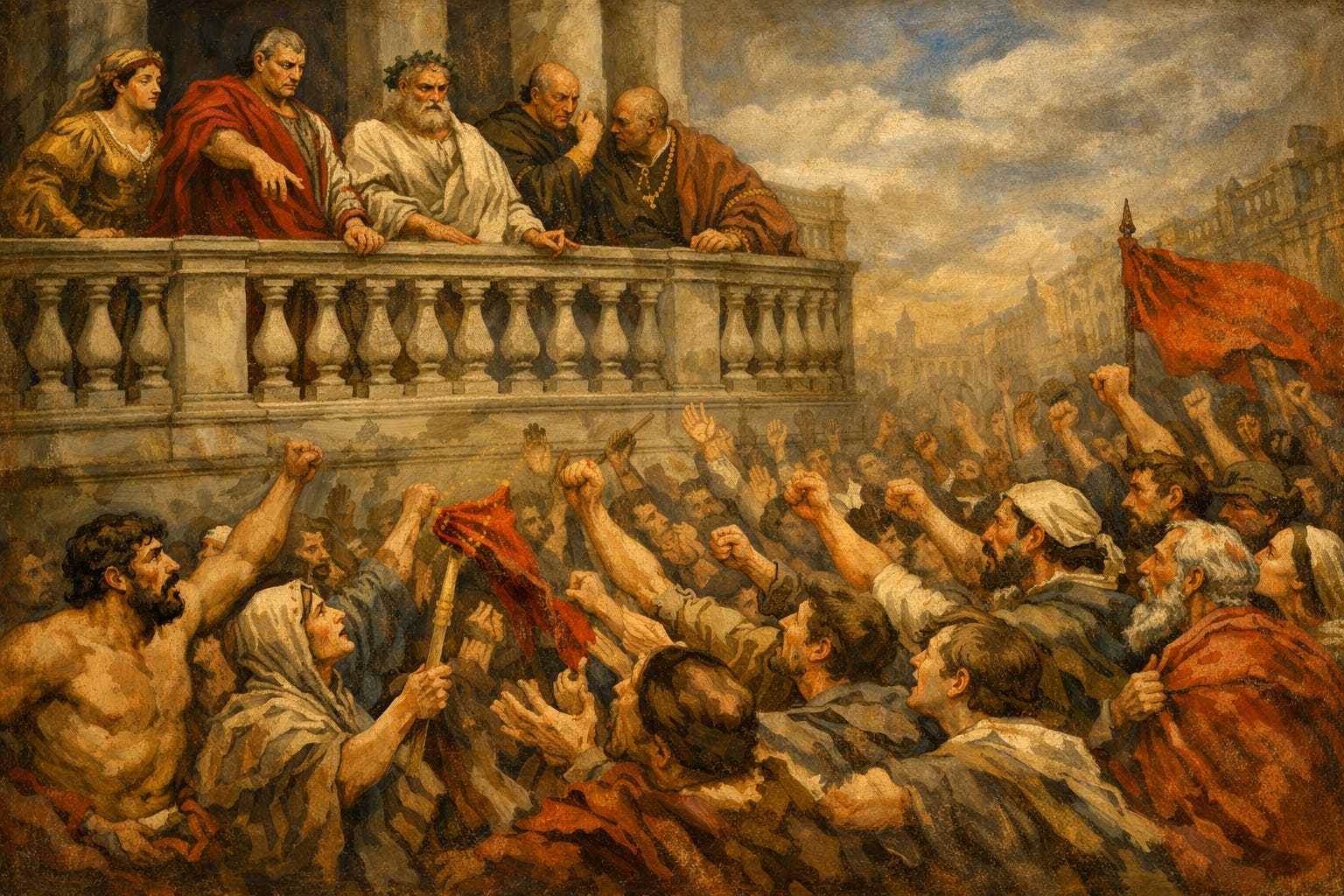
The hypocrisy of men is stunning. Throughout all of human history, political and historical figures alike have used rhetoric to gain popularity, influence, and power. The rhetoric they use is directed at the elite class, blaming them for all the woes of a society. They do this not because it is false, but because it is only a half-truth. The people share just as much blame in every society’s destruction as the elite class. But it is not advantageous for a figure to blame the people. Instead, they collapse rhetoric into a logical fallacy such as “US vs. THEM” and use every single problem that exists to condemn the oligarchs while absolving the people of any responsibility. Once this figure’s power is solidified, however, they create and furnish the very elite aristocracy as they had once condemned.
History has always taught us this lesson few have decided to listen. The masses are fickle. Their allegiances swing with their emotions and with what feels good in the moment. This is not to identify them as evil, malicious, or anything that could be considered harmful. That is simply their function in power. Figures who understand the function of the masses gain a significant advantage over those who merely contribute to it. This is not an unfounded or new idea. It is an identifiable and repeatable pattern shown to us across history. Those who do not understand history will always repeat it. But those who understand history and its patterns learn that history repeats itself regardless.
One of the clearest examples of this can be found in the period of the late Roman Republic. Popular leaders such as Julius Caesar distinguished themselves as champions of the common people. The rhetoric used at the time was directed at the Senate, which was framed as decadent, self-serving, and disconnected from Roman civic virtue. While this was partially true, there was also responsibility on the part of the people in the decline of their society. For instance, voters increasingly supported only those who promised immediate benefits rather than long-term stability. The people also demanded more games, entertainment, and spectacle from their leaders instead of addressing the long-term structural issues of the time. Finally, the masses were no longer loyal to the institutions of Rome, but to patrons and generals who paid for their loyalty, labor, and lives.
This demonstrates that the masses consistently favor instant gratification over long-term stability. They prioritize immediate benefit before future consequence. Populist figures, understanding the function of the masses and the desires of their base, used growing unrest, hatred, and disunity to gain power and influence in Rome. The power of the masses was not taken away or destroyed, but centralized under new charismatic figures like Caesar. Caesar and those who came after him did not destroy the oligarchy of Rome; they simply rebranded it. He made the elite class obedient to him. Elites no longer derived their power and influence from institutional authority, but from favor and proximity to Caesar and those who followed.
Another very prevalent example is that of the French Revolution. A figure like Maximilien Robespierre rose to power and prominence after the fall of the monarchy. He used rhetoric and political violence to direct the anger of the people toward the aristocracy. He framed the aristocracy and those of wealth and status as the singular problem in France and the cause of all its suffering. The rhetoric was effective because it was not false. It was true that the aristocracy at the time was corrupt, insulated, and extractive, but the masses also had a hand in the nation’s destruction. They widely relied on the monarchy and aristocracy to impose price controls on food and demanded immediate relief rather than long-term reform of the food supply. They also showed deep suspicion toward reform when it required shared burden or sacrifice.
This demonstrates that while the aristocracy bore significant responsibility for the fall of the French monarchy, the people themselves were not blameless. That responsibility was simply absolved by those they elevated to power. Robespierre’s rhetoric succeeded because it captured the impulses of the masses while absolving them of responsibility. Once power consolidated, the revolutionary leaders did not abolish hierarchy or aristocracy; they simply rebranded it. Titles were replaced with committees, nobility with loyalty, and the people cheered. They no longer had a king. They now had a ruling class as stable as their impulses.
It has been demonstrated clearly that the masses bear responsibility in the fall of societies as well. This reality is often obfuscated in state-sanctioned education, where societies are presented as collapsing solely because of elite failure, rather than through the combined actions of elites and the masses. Oligarchs are easy to blame throughout history because they are few in number, making it convenient to concentrate the failures of many onto the actions of a select few. But as you have seen, the masses are not peripheral to societal decline. They are a central force in instability and collapse. This is not widely taught because you are part of the masses. Those who understand power know that the masses serve a specific function within every system. That function is most effective when it remains unexamined. It is therefore advantageous to obscure this role, not to deceive out of malice, but to preserve utility. A population that understands its function ceases to be predictable. A population kept ignorant and distracted remains manageable, responsive, and easily mobilized.