
Your Enemies Are More Useful Than Your Friends
Only The Naive Believe Enemies Are Dangerous And Friends Are Safe

It is far safer to have many enemies than many friends. This statement seems to be a contradiction to popular belief and perception about friends and enemies. In reality it is one of the most important rules of power. An enemy confers more benefits than a friend will in most situations.
A friend poses more risks than an enemy does in most situations. Why is an enemy more useful than a friend? To understand this one must first realize the stakes in games of power. When men are competing for power, influence, and wealth no action is too extreme because every action on the board can potentially improve one’s own position. The only actions that are not taken are those that pose far too great a risk to the person taking the action.
Although sometimes rashness is an advantage. Sometimes it is a weakness or defeat. In games of power men compete until death, imprisonment, or the more common case, which is when men’s ambitions can be conquered with a payoff.
The question becomes who can one trust? The obvious answer is only oneself, because one’s enemies are always ready to strike and capitalize on one’s own weakness, but also friends are waiting for the cost of betrayal to outweigh the benefit of friendship. This is the mechanism that reveals why it is far safer to have many enemies. A man with many enemies can easily prepare for them, he understands their motivations clearly, he understands their capabilities and their respective threat to him. This allows him to fortify and strengthen his own position while preparing and insulating himself against his enemies.
The many consume. The few study. If you have read this far, you already know which one you are.
You’ve been reading the abridged version of our content. Become one of the FEW and receive these exclusive benefits…
Access to Foundational Works — PT’s exclusive long-form series 10+ Works unavailable to free readers
New full essays every Tuesday and Thursday, with potential weekend pieces
Direct Influence what we write about next in the subscriber-only chat
Full archive access — every essay, every framework, every structural analysis PT has published
Become one of the Few for only $12 a month or $120 a year
For instance, consider a man who controls a large portion of a society’s media. This man has many enemies because he has openly run stories of alleged corruption amongst a government. He quite uniquely understands this dynamic and has fortified himself with public opinion so any attack on him or his companies, however legitimate, will bring the government down. He is protected and insulated from the attacks of his enemies for a time, not forever but for a time. He correctly identified his enemies and ran stories that brought to light their alleged corruption. While he hurt those who opposed him he also fortified his own position with political alliances amongst the people.
Now imagine the same exact scenario except this man has a few powerful friends that are not as well insulated as the media magnate. The government will likely pressure his friends in a few key ways. They will coerce them to betray him with money, power, or force. Or they will intentionally and publicly humiliate and imprison them to send a message. This gives his friends incentive to betray him while justifying it by saying something like, it was either him or me. This is why the man with more enemies and fewer friends succeeds while the man with more friends will inevitably fail. His friends will be used as traitors or leverage depending on the level of loyalty they possess.
This example may be extreme but it clearly demonstrates the point. Friends will always be used; enemies, while being a nuisance, will always be a certainty on the board. This quite literally is the case through all levels of society, not just amongst the powerful but also amongst corporations and even in interpersonal relationships. The stakes may be vastly different so the actions that are taken will be vastly different as well, but the underlying mechanism is still quite clear. Enemies are a known quantity they can be prepared for; friends are an unknown liability that will be used. It is just far more clearly represented and understood in games of power.
Understanding this mechanism already gives a person a clear advantage. The naivety of having friends that care only about being a friend and nothing else will have worn, the idea that enemies are dangerous is now clearly wrong. Every person then must be treated as a situational neutral. Even if they are grouped into the friend or enemy category, a person must remain vigilant and understand the incentives that their supposed friends would have to betray them while also understanding that their enemies are a benefit because they can be grouped according to their capability and take up far less thought than previously given. Any emotion that gets in the way of these dynamics not only destroys advantage but weakens one’s own position because now they have become predictable.
While this is a part of power this is not a rule but a warning: power is fluid, every situation calls for a different strategy under a different set of circumstances.
Machiavelli called this concept “Fortuna”. He believed that power could be observed, studied, and applied in different situations but he also believed that Fortuna governs half of all human affairs and that power is farther outside the perception of those who study it than they care to admit.
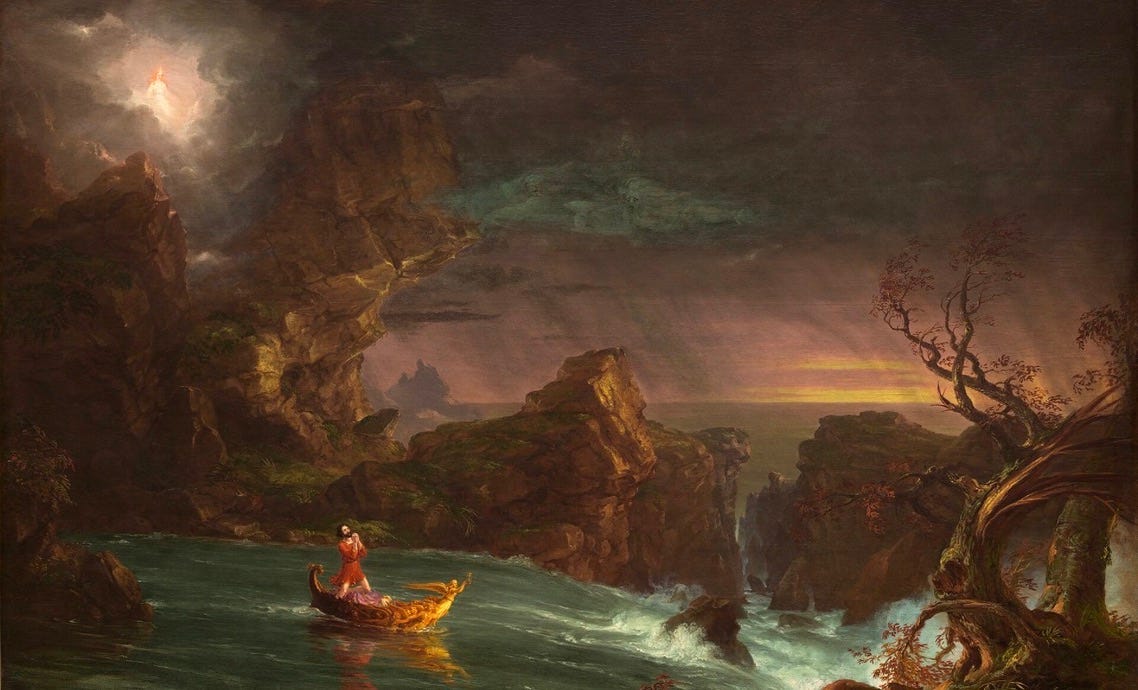
Some instances may include a more powerful friend that is depended upon, which changes the calculation quite a bit. Other situations include enemies that cannot be outlasted or overcome and that will result in defeat no matter what is done. This is why the concept of power has been one of the most elusive topics in all of history.
Power is dependent on situations and the context of those situations; there are no neat rules to follow so one can prevail. Only a sharp mind, a cunning attitude, and a thirst for knowledge may conceptualize the more obvious outcomes of power.
Good article! Perhaps the deeper meaning behind “Keep your friends close and your enemies closer” is not strategic at all. Friends show us how we fit into the world; enemies show us where we collide with it. One affirms our strengths, the other exposes our edges. A life without critics may be comfortable, but it often leaves a person partially unknown to himself.
Fantastic post. In a way Carl Schmidt took this a step further. He said that democracy will always fail in the long run because democracies inherently aren't set up to make the friend-enemy distinction. Enemies are useful in the sense that they bring people together (WW1 Germany, Britain, WW2 Germany, Britain, Cold War USA, Russia). Seemingly a paradoxical idea until you think about it in terms of your post.